
To answer this question, you first need to understand the technical side of the matter.
ISP proxies (Internet Service Provider proxies), also known as static residential proxies, are a hybrid type of proxy that gives you data-center speed and IP address privacy. They use real ISP-assigned addresses, making them nearly indistinguishable from regular users.

Your internet traffic passes through an intermediary server with an ISP‑issued IP address. This server hides your real IP by substituting its own, and relays data between you and the target site. As a result, the site sees only the “clean” ISP IP, while you maintain full privacy and enjoy high connection speeds.
A key feature of this proxy type is the static IP address. This means that throughout the entire usage period, the IP address does not change and remains the same.
ISP proxies are limited in the number of IP addresses available, which in turn restricts their geographic coverage. This means that the number of IPs in a particular country may be small or even nonexistent.
Advantages of this type:
- High connection speed
- Reliability – generally more stable operation
- Longer session lifetime
- Low risk of being blocked
Disadvantages:
- High cost
- Limited number of IP addresses
- Less geographic availability
Residential proxies use IP addresses of real users who voluntarily (or through an installed application) share their internet traffic with the provider. Your request passes through an ordinary person’s computer or smartphone in some country. Essentially, this is a brokerage service where one user lends their IP address to another user.
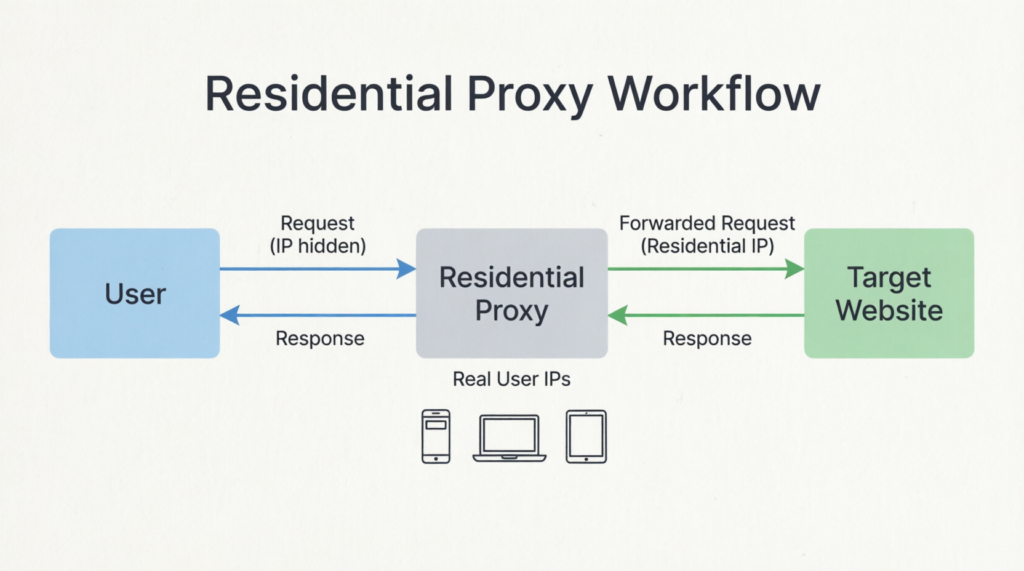
You can choose different agent rotation options both before starting and during the process, filtering IP addresses by country, city, and so on.
Also important is the legality of how such agents are collected – some services use various illegal methods to recruit agent proxies. This can complicate working with such IP addresses.
Advantages:
- Large number of IP addresses
- Wide geographic coverage
- Ability to select the desired location, country, or city yourself
- IP rotation
- Very low detection risk
Disadvantages:
- Speed depends on the agent’s internet speed
- Cost can sometimes be high, but due to high market competition, you can find affordable offers
When comparing Residential proxies and Data‑center proxies, one can conclude that:
- ISP proxies are ideal for tasks that require fast and stable connections, such as web scraping, social media management, and online gaming.
- Residential proxies are best suited for tasks like accessing geo‑restricted content, market research, and ad verification.